

Chevy Suburbans From 1935 to 2020

Among used SUVs, the Suburban reigns supreme. Since 1934, Chevrolet has released twelve generations of the famed vehicle, and while manufacturers continue to move towards more green and energy-efficient vehicles, the Suburban remains the only vehicle in its class that can handle as many passengers, as much cargo, and still have an impressive towing capacity on top of everything. For large families, busy groups, and ultimate adventurers, the Suburban is a go-to vehicle that can accomplish nearly anything. It’s easy to see how a 2018 study conducted by iSeeCars found the Chevy Suburban to be the most driven car per year. In even better news, a study by the same site in 2019 identified the Suburban as being among long-lived vehicles. Between their longevity, reliability, and flexibility as a multi-purpose vehicle, it’s easy to see why a used Suburban would be highly sought-after by many individuals and families. For those looking at used SUVs, and specifically Suburbans, it might be a bit confusing to wade through all of the details- after all, twelve generations and 85 years of production lead to a lot of options. While most people looking for daily drivers won’t search earlier than the eighth-generation, which came on the market in 1992, there are some details every driver can learn from the history of the King of SUVs, the Chevy Suburban.
A Brief Historical View of the Suburban
The first-generation of the vehicle we now know as the Chevy Suburban appeared in 1935, under its full name: the Carryall Suburban. It seems that even in the ’30s, automobile manufacturers were called to produce a vehicle that could literally carry everything—a family, a bunch of belongings, and still be rugged enough to handle undeveloped roads.
The first-gen Suburban was essentially a sheet metal based station wagon on a small half-ton truck chassis. With three rows of seats that could accommodate eight passengers, and either a rear liftgate or side-hinged panel doors for access to the cargo area, this was truly one of the first vehicles of its kind, and the concept took off.
Interestingly enough, it wasn’t until the sixth-generation—which was released in 1960—that four-wheel drive became an option. Drivers could choose between the C model, which was the standard 2WD, or the K, which was the newly introduced 4WD. It was this generation that also introduced the concept of having a choice between multiple engines.
The Birth of the Modern Suburban
There is some argument as to whether the Suburban, as we know it now, was officially introduced in the 1970s or the 1990s. For the modern driver, models older than the eighth-generation—which was released in 1992—might not be practical. They do not come equipped with rear antilock brakes, aren’t known for their great speed or pick up, and weren’t designed to be fuel-efficient. The 1980s truly were a different time!

That being said, a reliable and usable vehicle can still be found in the eighth-generation of Chevy Suburbans. 1992-1999 were great years for the vehicle, as it was largely the only SUV in the full-sized wagon market with payload and towing ratings comparable to a truck AND the ability to seat up to nine passengers.
The mechanics of the eight-gen Suburban were still pretty simple, which is great for modern-day maintenance, but offered more power and capability than previous models. Drivers enjoyed a standard 5.7L V8 standard engine with 210 horsepower, but some opted for the heavy-duty version or a 7.4L V8. All Suburbans in this generation have a 4-speed automatic transmission but offered the option of 2WD or 4WD with antilock brakes on all four wheels.
While safety features can hardly compare to what’s available in today’s market, a drivers-side airbag was added to the 1995 Suburban, and the passenger side arrived in 1997. The 1998 version saw the addition of full-time 4WD, known as Autotrac. While rollover can be a risk in these earlier models, due to a narrow track for improved maneuverability, this was the age when that danger was quickly addressed.
The New Millennium and New Generation
The ninth-generation of Chevy Suburban was released in 2000, and this generation manages to hit the balancing point between plush nostalgia and modern convenience. For example, this was the swan song of the ultra-thick luxury seats, but the introduction of the second-row captain-style seats and built-in DVD players.
One of the most lauded transitions within this generation was the introduction of the 5.3L Vortec V8 engine, and while the extremely powerful 8.1L V8 made its exit during this period, this 340 horsepower engine can be found in the 2001 models.
Overall, this generation is truly appreciated as one of the best among used Suburbans, as it has the most durable mechanics and most enjoyable features, as higher trims were developed during this time frame, including the Z71. The 2003 edition introduced Quadrasteer, which worked to improve turning and towing stability, as well as tri-zone climate control, and really convenient additions like power-adjustable brake and gas pedals. Leather interior options, OnStar, and steering wheel audio controls were also modern additions that arrived in this generation.
A Generation of Improvement
The modern Chevy Suburban hit its stride with the tenth generation, which reigned from 2007-2014. For those searching for a gently used Suburban, consider the tenth generation, which includes re-engineered mechanics for fuel efficiency, as well as modern safety and technological features.
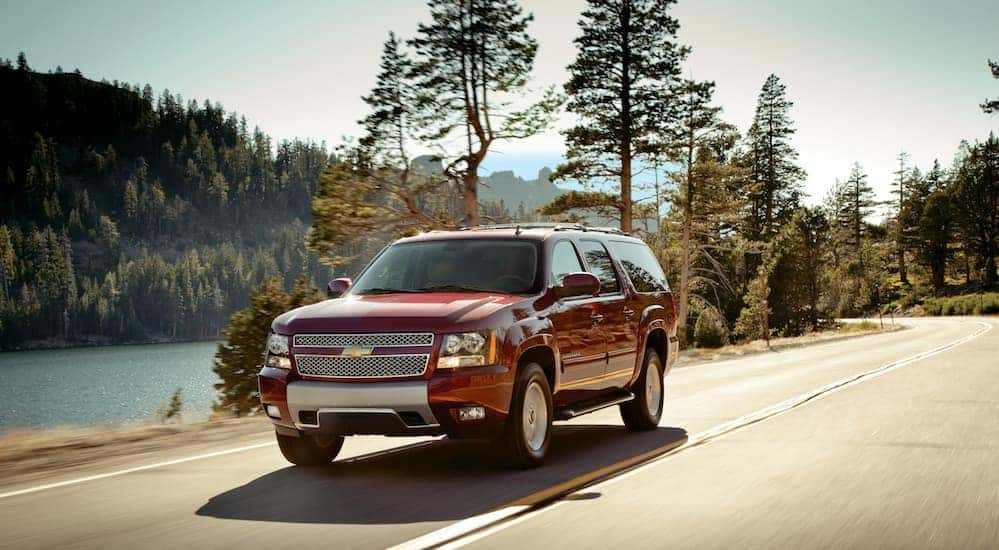
The 5.3L Vortec engine and standard 6-speed automatic transmission were re-tooled for this generation, resulting in greater overall power, and fuel efficiency that made the Suburban more comparable to other vehicles in its class. Other design elements were also updated, including the overall shape and aerodynamics of the body style, and a chassis that provided an elevated level of comfort and performance. This was the first generation to feature body-color bumpers, instead of chrome, too.
Safety features like Side Blind Zone Alert, electronic trailer control, hill start assist, and standard stability control became commonplace features. The Chevy Infotainment system also came aboard, helping drivers maintain connectivity and manage entertainment selections with hands-free ease. Trims included the LS, LT, and LTZ, each of which added upon the luxurious comfort features of the previous trim, including ventilated leather, heated seats and steering wheel, and climate control options for the second and third-row passengers.
Today’s Suburban
The eleventh-generation Suburban hit the market in 2015 and will conclude with 2020 models. Perhaps the most common used Suburbans on the market, these vehicles are modern classics that will have plenty of years and miles left on them.
A quick glance at the 2020 Chevy Suburban stats reminds us why this vehicle has endured for over 85 years. From its 121.7 cubic feet of cargo space, seating for nine passengers, and towing capacity up to 8,300 pounds, to the plentiful interior storage spots, heated leather bucket seats, and power liftgate, it’s easy to see why this vehicle is the number one choice for large families and those who like to go places and do things. The 5.3L V8 engine remains, now with 355 horsepower and 383 lb-ft of torque to power the higher towing capacity, and a 6.2L V8 engine is available on higher trim levels.
When looking at used SUVs, the Chevy Suburban should be on your list, especially if you’re looking for a classic vehicle that can handle nearly every situation you can throw at it. Whether the roads you travel are unpaved, or your journeys require a tow-along trailer, or if you simply have a handful of people who need to join you along the way, a used Suburban is a popular and useful investment. If you are looking for a used Suburban, visit our dealership in Buford, GA, today!
0 comment(s) so far on Chevy Suburbans From 1935 to 2020