

Best Chevy SUV Engines – V8 or Turbocharger?

An SUV may not be either a truck or a sports car, but that does not mean that a good engine is unimportant. Whether you are looking for off-road performance, towing ability, or simply good acceleration on the highway, having a powerful engine is key. In the past, vehicle power was directly linked to engine size, with large V6 and V8 engines ruling the roads. However, technology has progressed, and today, reliable turbochargers are used to give much smaller engines similar levels of power. A look at the current lineup of Chevy SUV models reveals a mix of both traditional high displacement engines and modern small turbocharged engines. If you are wondering which Chevy SUVs still have a V8, then the answer is the Chevy Tahoe and Chevy Suburban.
Now before diving into the technical details of Chevy’s SUV engines, we should take a moment to review some basic terminology and concepts. Engine size is measured by “displacement,” or the amount of volume inside its cylinders. In the past, this was usually referred to in terms of cubic inches, but today, the standard measurement is liters. As engine volume goes up, more fuel and air can be mixed inside of it, and more power can be produced. And the best way to increase engine volume is to add more cylinders, resulting in large V6 and V8 engines. However, more power can also be produced through the use of a turbocharger. This is a small fan powered by exhaust gas that is used to pump more air into the engine than it could normally hold and thereby produce more power. In the past, turbochargers were unreliable and confined to high-performance sports cars, but advances in technology have now made them common across all vehicle types.
The Mighty V8
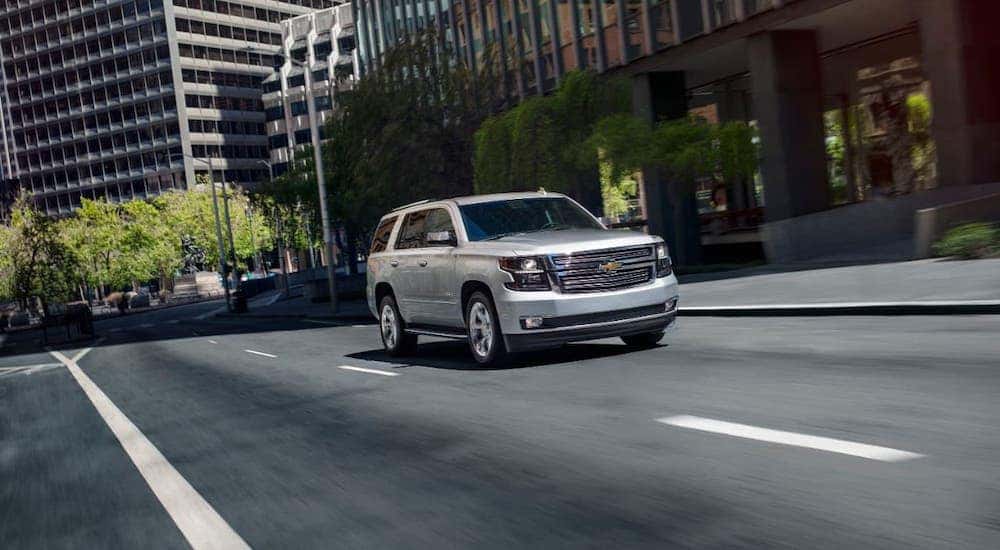
Today there are only two Chevy SUV models that come with a V8 engine. These are the top-of-the-line Chevy Tahoe and Chevy Suburban, which share the same engine options. And although these two SUVs have been substantially redesigned for the 2021 model year, they have retained the same engine options as the outgoing 2020 model year vehicles.
The base engine for the Chevy Tahoe and the Chevy Suburban is a V8 5.3-liter that can produce up to 355 horsepower and 383 lb-ft of torque. And despite the almost three-ton bulk of these SUVs, this engine is powerful enough to provide them with solid acceleration as well as allow them to tow over 8,000 pounds. However, if even more power is desired then the top High Country trim is available with an even larger 6.2L V8 engine generating 420 horsepower and 460 lb-ft of torque. And while this more powerful engine does not increase the tow rating of these Chevy SUV models, it does noticeably improve their acceleration.
With their high horsepower and torque figures, these two V8 engine options make the Chevy Tahoe and Chevy Suburban the clear winners for drivers seeking maximum power. However, maximum power does not necessarily translate into maximum performance. While raw horsepower and torque are critical for towing, when it comes to acceleration, the more important consideration is a vehicle’s power to weight ratio. And here, the high weight of the Chevy Tahoe and Chevy Suburban is a clear handicap.
The lightest Chevy Tahoe weighs in at around 5,500 pounds, while the larger Chevy Suburban tips the scale at around 5,700 pounds. This gives them a power to weight ratio of nearly 16 pounds per horsepower with their base engine and a bit over 13 pounds per horsepower with the top engine. Now the average SUV is generally around 20 pounds per horsepower, so these numbers are not bad by any stretch of the imagination. But for drivers who do not need the raw size of the Chevy Tahoe and Chevy Suburban, better performance can actually be found more cheaply in some Chevy SUV models that do not have V8 engines.
The V6 and Turbo-4
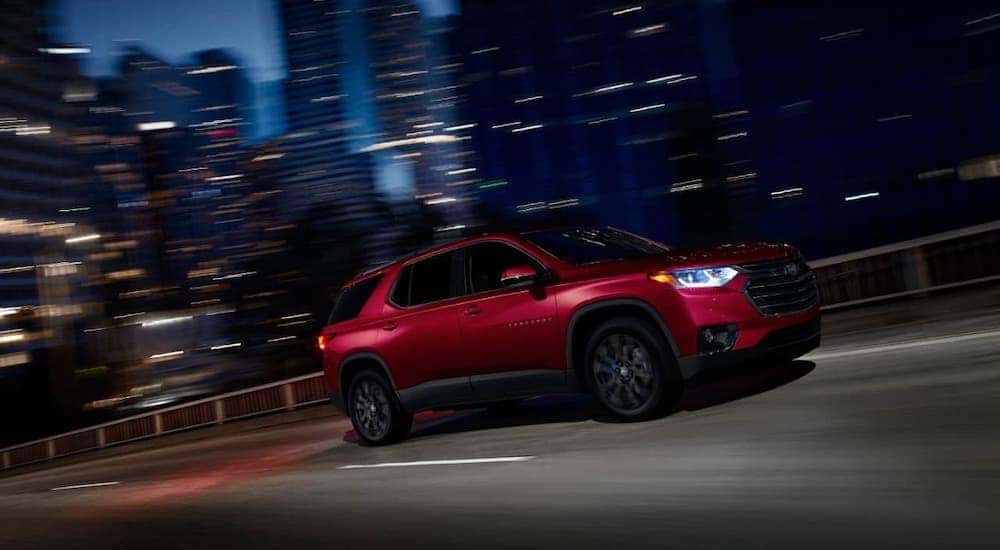
The first alternative is the 2020 Chevy Traverse, with its V6 engine. Although not quite as large as the full-size Chevy Tahoe and Chevy Suburban, the Chevy Traverse is still a three-row SUV with plenty of space for passengers and cargo. Powered by a 3.6L V6 producing 310 horsepower and 266 lb-ft of torque, this Chevy SUV may seem substantially weaker than the V8 models. However, at around 4,400 pounds, the Chevy Traverse is over a half-ton lighter than its full-size counterparts. This gives it a power to weight ratio of around 14 pounds per horsepower, which is better than a Chevy Tahoe or Chevy Suburban with the base 5.3L V8 engine, but not quite as good as one of those full-size SUVs with their top 6.2L V8 engine. However, thanks to its smaller engine, the Chevy Traverse is far more efficient and gets 21 MPG combined instead of the 16 to 18 MPG combined of the V8 Chevy SUV models. So while a Chevy Traverse will never match the generous tow rating of the Chevy Traverse or Chevy Suburban, it is an excellent option for drivers seeking capability, performance, and efficiency.
However, the fastest Chevy SUV model is the Chevy Equinox, which has neither a V8 nor a V6. Instead, it uses a modern small turbocharged four-cylinder engine. But despite displacing just 2.0-liters, this engine still generates a respectable 252 horsepower and 260 lb-ft of torque. And since the much smaller two-row Chevy Equinox weighs in at around 3,300 pounds, this engine is enough to produce an excellent power to weight ratio of roughly 13 pounds per horsepower. That puts the Chevy Equinox with its 2.0L four-cylinder engine a hair ahead of the Chevy Tahoe with its massive 6.2L V8. And to top it off, the smaller SUV even gets 25 MPG combined. However, the Chevy Equinox also comes with an even smaller 1.5L turbocharged engine that only has 170 horsepower and 203 lb-ft of torque, giving the SUV a thoroughly average power to weight ratio of around 19 pounds per horsepower. So if you do want this fun Chevy SUV, make sure that you are looking at one with the right engine.
So what is the moral of this story? First, vehicle weight can be just as important to performance as engine power. Second, adding more cylinders is not the only way to create a more powerful engine. When these two lessons are combined, it becomes clear that you might be able to get more performance by forgoing that large V8, and instead, selecting a smaller engine in a lighter SUV. However, smaller vehicles do not work for everyone’s lifestyle, and Chevy certainly deserves to be commended for continuing to use monstrous V8 engines in its top-of-the-line SUV models when other manufacturers have switched to less powerful engines. This decision means that these mighty machines continue to be some of the most powerful and versatile vehicles on the road.
0 comment(s) so far on Best Chevy SUV Engines – V8 or Turbocharger?