

Chevy’s Aggressive Ev Strategy Promises an All-Electric Lineup by 2035

As the premier Lawrenceville Chevrolet dealer, Rick Hendrick Chevrolet of Buford is in a unique position to represent an iconic American car brand. Chevrolet turned 100 in 2011, and since then, the automaker has continued its storied tradition of innovation. The next chapter is all about electrification. Namely, an all-electric future that includes 30 new electric vehicles by 2025 and the elimination of combustion engine power by 2035.
General Motors, Chevrolet’s parent company, pledged to do its part to combat climate change with its bold commitment to a zero-emissions future. The effort includes a $35 billion investment in infrastructure, including Factory ZERO, the first-ever GM plant devoted solely to EV production. Industry insiders believe the automaker’s Ultium battery technology allows for low-cost mass production, which will keep electric vehicles affordable for all buyers.
Today, Chevy’s EV lineup includes the Bolt EV and the Bolt EUV, along with the upcoming Chevy Silverado full-size pickup, rumored to offer class-leading capability. Future EV models include the mid-size Blazer crossover and the Equinox. Chevy CEO Marry Barra confirmed that the automaker also plans an all-electric Chevy Express cargo van in the near future. What does all this mean for buyers? Here’s our take on Chevy’s EV revolution.

Ultium Battery Technology Leads the EV Industry
In the early EV R&D days, engineers struggled to overcome the challenge of designing a battery pack that provided gas engine-like performance and adequate driving range without adding excessive bulk and weight. GM knew that winning consumers over to an EV lifestyle meant eliminating objections like range anxiety and overcoming the widely-held stereotype that EVs were boring and underpowered.
The stigma originated with Toyota’s egg-shaped Prius, a practical (a.k.a. underpowered) hatchback with a hybrid powertrain, and a favorite of tree huggers everywhere. Even Chevy’s first generation Bolt EV took some jabs for its styling, despite winning Motor Trend’s prestigious Car of the Year award in 2017. Still, with a range of approximately 238 miles and fuel economy ratings at a staggering 238 mpge, the Bolt EV quickly became the second best-selling alternative fuel vehicle.
Today, GM employs its Ultium battery technology on all production EVs. The next generation Ultium battery packs are projected to cost 60 percent less than the ones found on today’s model year Chevy EVs, yet they’ll offer even more energy density, which means opportunities to extend range and increase performance and capability. Ultium batteries are vertically stackable, giving designers freedom to design vehicles with flat cabin floors and adjust centers of gravity to meet performance standards and optimize handling.
Even with the latest battery technology, no EV is practical without access to charging stations. That’s why GM is working with EVgo to build an additional 2,700 fast-charging stations in the next five years, adding to the existing network of 60,000 plugs scattered throughout North America. GM is also partnering with Qmerit, a national EV charger installer, to facilitate home charging outlet installations for EV buyers.
A Preview of the Upcoming Chevy EVs
Think Chevy isn’t serious about total electrification? Consider this: the company’s next EV launch involves transforming one of its flagship nameplates in a category that doesn’t typically welcome big changes. It’s the Silverado, Chevy’s legendary full-size pickup, and in the 2024 model year, it’s available with an all-electric powertrain. The 2024 Chevy Silverado EV is reported to offer a 400-mile driving range and up to 664-horsepower, along with 780 lb-ft of torque. That means it’ll be the most powerful Silverado half-ton in history.
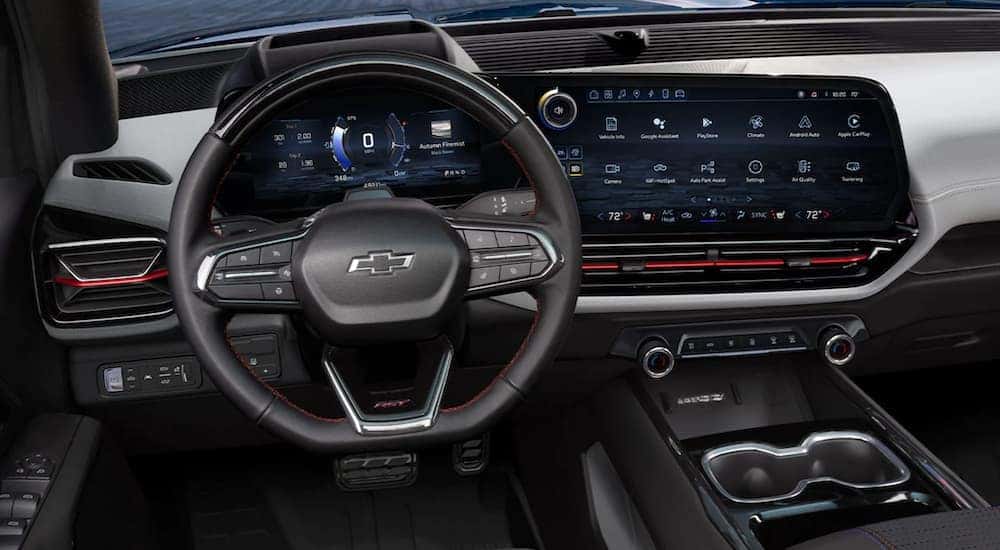
Chevy will initially offer the highly-anticipated Silverado EV in two trims: the fleet-focused WT and the RST First Edition. Expected towing capability comes in at a max of 10,000 pounds, with max payload at 1,300 pounds. These electrified trucks can also serve as mobile generators via an available PowerBase charging system featuring 10 outlets and 10.2kW of power. All Silverado EVs come in a Crew Cab configuration and include infotainment touchscreens as large as 17 inches.
Chevy recently announced its plans to electrify the popular mid-size Chevy Blazer SUV. The upcoming Blazer is a performance-oriented model, the first-ever EV to carry Chevy’y legendary SS–or Super Sport–nomenclature. Also on the list of crossovers slated for electrification is the best-selling Equinox, a compact crossover first introduced in the 2005 model year. Chevy estimates a starting price of just $30,000, putting the Equinox EV in reach for budget-focused buyers.[a] It makes sense that Chevy is focusing on its ute lineup, since it’s the automaker’s most popular body style.
Also ahead is the Chevy Express Van and a medium-sized commercial truck. While Chevy has been mum on specific details, insiders at GM Authority report that company executives are bullish on demand, since the vehicle is targeted for fleet sales primarily to delivery companies. Chevy’s plans to electrify its commercial cargo van is no surprise, since GM has announced the formation of BrightDrop, a division that seeks to support the $850 billion package delivery business, a sector that’s poised to grow another 78 percent by 2030.
What Is Factory Zero?
GM is investing big bucks in electrification, including constructing Factory ZERO, a vehicle assembly plant reserved for building EVs. The plant, originally built in 1985, Factory ZERO is ground zero for the auto giant’s zero-emissions future. The upcoming Chevy Silverado EV pickup will be built at the plant, as well as the Cruise Origin, a self-driving car concept slated for commercial use when it’s ready for production.
Factory ZERO is home to GM’s most advanced manufacturing technology, and the facility is expected to run on 100 percent renewable energy by 2023. During construction, demolished concrete was repurposed into roadway, and intricate landscape design efforts included creating a certified wildlife habitat within the factory’s footprint. Factory ZERO also contains a complex stormwater management infrastructure for recycling and reusing runoff. Perhaps most impressive is the use of CarbonCure, a type of concrete that absorbs air polluting CO2.
Technology plays a prominent role in Factory ZERO’s EV assembly process. It’s the first American auto plant to install Verizon’s 5G Ultra Wideband network technology, a decision that paves the way for highly advanced automation throughout the manufacturing process. The 5G network powers GM’s sophisticated robotics, including the fleet of Automated Guided Vehicles that zig zag around the factory floor, distributing materials where they’re needed. With thousands of connected devices using network bandwidth across the 4 million square foot facility, 5G technology keeps data moving fast.
The Future Is All-Electric
Chevy’s transition to an all-electric future involves mass producing EVs that every buyer can afford. While other manufacturers reserve their EV models for luxury buyers, Chevy takes a different approach to electrification using the same tried-and-true strategy, which is to make value and affordability a priority. We expect some Chevy EV models to lean toward a luxury-oriented demographic, but to meet its aggressive electrification goals, EVs must be affordable for every buyer.
Add to that the company’s efforts to expand the nation’s network of charging stations and provide EV buyers an easy route to at-home charger installation, and it’s a recipe for success that other automaker’s are scrambling to imitate. GM’s Ultium battery technology is improving at a rapid rate, so we can expect even more powerful vehicles with extended driving ranges that rival gas-powered alternatives. It’s time to get excited about the EV revolution.
0 comment(s) so far on Chevy’s Aggressive Ev Strategy Promises an All-Electric Lineup by 2035